
How to take a rest day without losing your streak
How do you take a rest day without losing your streak? Plan days off before you need them. Here's what research says about missed days, and how to do it.

To take a rest day without losing your streak, decide your days off in advance and use a tracker that counts them as planned rather than as a miss. Rest days built into your schedule shouldn’t touch the count, and a small allowance of extra days off covers illness and travel. Research suggests a single missed day does little harm, while how you react to it matters a lot.
This guide covers what studies say about streaks and missed days, how to set up your own days off, and what to do when a streak breaks anyway.
Quick answer
- Plan rest days up front: build them into your schedule so they never count against you.
- Keep a few spare days: an allowance covers illness, travel and bad weeks without breaking the chain.
- Don’t panic over one miss: in one study of 96 volunteers, missing a single day didn’t derail habit formation.
- Restart fast: people who blamed themselves for a broken streak were least likely to carry on.
- Pick the right tracker: check what counts as a break before you start, because apps differ.
- If you use Fitlock: since version 1.9, each schedule has a streak and up to two holidays a month on the free plan, with more on Pro.
Do streaks help you keep going?
They can. In a seven-study paper in the Journal of Consumer Research, Jackie Silverman and Alixandra Barasch found people were more likely to continue when an app showed an unbroken streak than when it showed a broken one, even when they’d done exactly the same things.
In one experiment with 601 online participants using a mock fitness app, 66% did another exercise when they saw an intact streak, against 58% when they saw a broken one. In a 30-day workplace challenge with 980 employees, people were more likely to hit 7,000 steps the day after a run of successes than the day after a run ended. That one’s correlational, so it can’t show the streak was the cause.
Most of the experiments used short tasks with paid online participants, not months of real training. We also couldn’t find a good study of streaks lasting 100 days or more, or of how losing a long streak makes people feel. So streaks look like a helpful nudge, not a guaranteed way to build a habit.
What happens if you miss a day?
Probably less than it feels like. The best-known habit study, Lally and colleagues in 2010, followed 96 volunteers repeating a daily eating, drinking or activity habit for 12 weeks. Missing one opportunity didn’t materially affect habit formation. Time to reach a settled habit varied from 18 to 254 days, so be wary of anyone promising a neat 21 days. A 2024 review of 20 studies also found that habits often take a couple of months or more, with big differences between people.
For exercise, the weekly total seems to matter more than a perfect pattern. In a study of 350,978 US adults, those who fitted their weekly activity into one or two sessions had mortality rates similar to those who spread it over three or more, once the total was the same. That’s an observational link rather than proof, and it says nothing about phones, but it’s a good reason not to treat one quiet day as a failure.
We couldn’t find a trial that directly tests planned rest days and sticking with exercise, so the next section is the closest evidence we have.
Why planned days off work better than willpower
The most useful research here is on what its authors call emergency reserves: a small number of skips built into a tough goal. In a five-week walking experiment, around 245 university students and staff were given a step goal under different rules:
| Goal | Rule | Average steps a day |
|---|---|---|
| Easy | Hit it 5 days a week | 6,662 |
| Hard | Hit it 7 days a week | 6,678 |
| Reserve (weekly) | 7 days, with 2 emergency skips a week | 7,754 |
| Reserve (monthly) | 7 days, with 8 emergency skips over four weeks | 7,981 |
People with skips walked about 1,000 steps more a day than people with no skips. They were also more likely to hit the goal the day after a miss, at about 55% against 37% for the hard goal. The researchers’ explanation is that people tried not to use their reserve, and that having one kept them committed after a slip.
There are two catches. The skips carried a small cost by design, so this doesn’t show that unlimited free days off would work, and the steps were self-reported with screenshots at one US university. A limited allowance is what the study supports.
Duolingo does something similar. Its Streak Freeze lets learners pause a streak for a day, and Duolingo says that allowing two at a time raised daily active learners by 0.38%, without learners taking more days off. That’s the company’s own figure, for language learning rather than exercise.
How to set up rest days that stick
- Choose your training days. If your goal runs Monday to Saturday, you don’t owe anything on a Sunday.
- Set a small allowance. We’d suggest starting with two a month, which is also what Fitlock’s free plan gives you. The walking study above kept its skips limited too.
- Book the ones you can see coming. A holiday, a wedding or a long-haul flight shouldn’t catch you out.
- Save the rest for surprises. Being ill is the obvious one. Most exercise can wait until you’re well again.
- Set a goal you can hit on a bad day. The easier a goal is to reach when you’re tired, the fewer days off you’ll need.
- Review weekly, not daily. A quick look on Monday tells you more than worrying about one day.
Do holidays break your streak in Fitlock?
No. We make Fitlock, and version 1.9, released on 30 October 2026, added streaks and holidays to every schedule. A schedule is the set of apps Fitlock locks and when, and each one keeps its own streak. Every day the schedule runs adds a day.
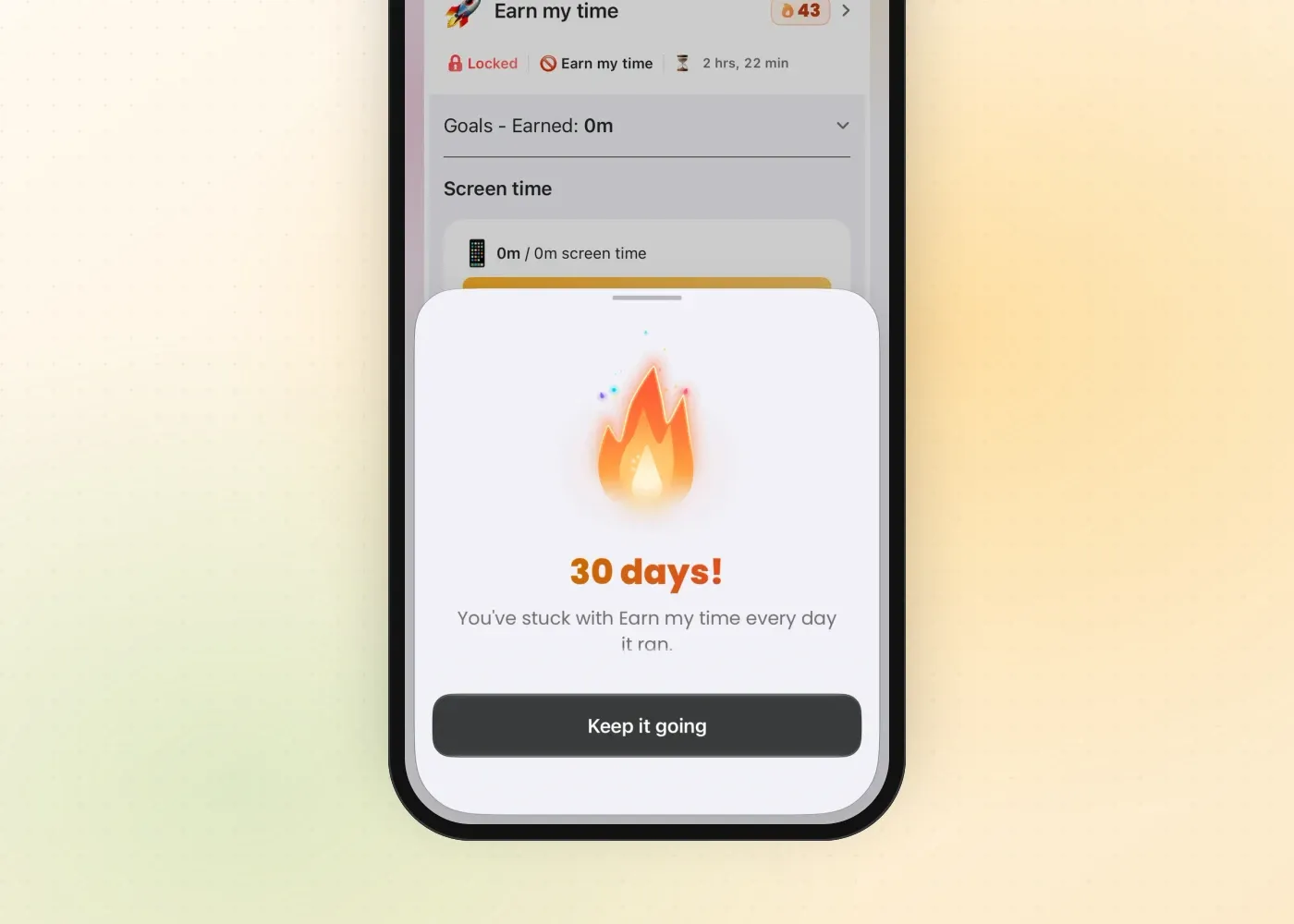
Here’s what does and doesn’t affect a streak:
| What happens | Effect on your streak |
|---|---|
| The schedule runs for the day | Adds one day |
| A day the schedule isn’t set to run | No change |
| You take a holiday | No change |
| You take a short break during the day | No change |
| You make the schedule tougher, or rename it | No change |
| You switch it off, delete it or make it easier | Breaks it, after a warning |
| Your Fitlock Pro subscription lapses | Pauses it for 30 days instead of breaking it |
A streak is a record, and it never affects what gets blocked.
A holiday gives one schedule a day off. It blocks nothing and asks for no goals, and you don’t earn any time that day. You set your allowance in the schedule’s settings, and on the free plan it’s up to two a month. With Fitlock Pro, it’s up to three a week, ten a month or thirty a year.
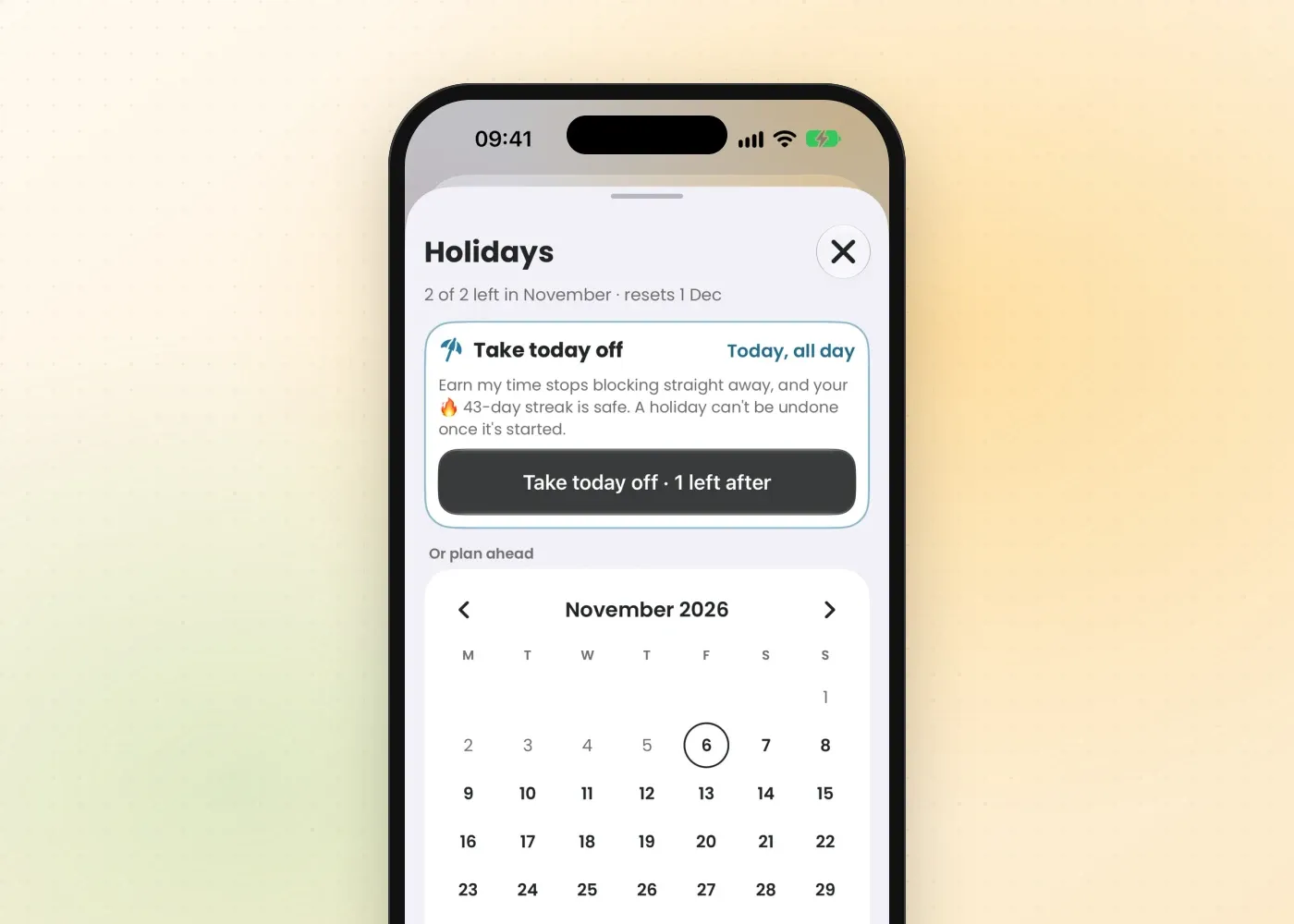
Fitlock keeps a few rules so holidays stay meaningful. Once today’s holiday has started, it can’t be undone. On Strict difficulty, you have to book by the day before. You can lower your allowance whenever you like, but raising it or changing its period resets your streak, so a rough afternoon can’t turn into an unlimited supply of days off.
What to do when a streak breaks anyway
It’ll happen eventually. How you respond seems to matter more than the break itself.
In the same Journal of Consumer Research paper, 53% of people carried on after an intact streak, 42% when the break had an outside cause, and only 29% when they blamed themselves. In another of its experiments, 85% carried on when a broken streak could be repaired, against 69% when it couldn’t. These were short game tasks online, so take the exact figures lightly, but the direction is useful.
- Name the cause. “I had a fever” is more accurate than “I’ve got no discipline”.
- Start again on the next day you’re due. Don’t wait for a perfect moment.
- Use a fresh start if you need one. Researchers analysing gym attendance and Google searches found goal-related behaviour rose at the start of a new week, month and year. A Monday is a reasonable place to begin again.
- Remember your best. Fitlock keeps your best streak on the schedule’s progress screen, so a reset doesn’t wipe your record.
Keep moving, and take the day off
A streak should give you a reason to get moving on an average day, without making you exercise when you’re ill. Our guide to earning screen time with exercise can help you pick a goal you’ll keep up, and how many steps a day you need can help you set the number. Fitlock’s weekly story and Insights make it easy to see how your weeks add up.
Download Fitlock on the App Store to start a streak with a couple of days off built in.