
How many steps a day do you need?
How many steps a day should you aim for? Here's what The Lancet and JAMA studies found, and how NHS and WHO guidance frames activity in minutes instead.

Ask how many steps a day you need and most people will say 10,000. It’s a common default on fitness trackers, but it wasn’t handed down by a research panel. It started as the name of a pedometer a Japanese company sold in 1965, and the studies that have tested it since suggest the figure that matters for your health is lower, and that it shifts with age.
That’s not a reason to stop moving. Large observational studies published in The Lancet Public Health and JAMA have found that taking more steps is consistently linked to a lower risk of dying during the study period, at least up to a point. Where that point sits, and what it means for a daily step goal, is worth ten minutes of your time.
Quick answer
- The “10,000 steps” figure began as a 1965 marketing name for a Japanese pedometer, not a health recommendation.
- A 2022 meta-analysis in The Lancet Public Health found the mortality benefit of extra steps levelled off at roughly 6,000 to 8,000 steps a day for adults 60 and over, and 8,000 to 10,000 for adults under 60.
- A study of older women in JAMA Internal Medicine found benefits levelling off from around 7,500 steps a day, with meaningful gains starting from as few as 4,400.
- The NHS and WHO don’t set a step target at all. Their guidance is framed in minutes of moderate or vigorous activity a week, not steps.
Where the 10,000-step figure came from
The number has a name in Japan: manpo-kei, which translates roughly as “10,000-step meter”. A Japanese company launched a pedometer under that name in 1965, and the round figure stuck because it made a catchy product name, not because anyone had tested it as a health threshold. That’s according to research summarised by Harvard Health Publishing, citing Dr I-Min Lee of Harvard Medical School, who has spent years studying step counts and mortality. There was no clinical trial behind the number. It was an advertising slogan that arrived decades before wearable technology existed to test it properly.
So, how many steps a day do you need?
Once researchers had the accelerometers and pedometers to check the 10,000-step figure against real outcomes, a clearer, more age-dependent picture emerged.
The Lancet Public Health meta-analysis
In 2022, a team led by Amanda Paluch pooled data from 15 cohort studies across several countries, covering 47,471 adults, in a meta-analysis published in The Lancet Public Health. Over a median follow-up of 7.1 years, 3,013 participants died. The researchers grouped participants into four bands by average steps per day, with median values of 3,553, 5,801, 7,842 and 10,901.
Compared with the lowest band, the risk of dying during the study was 40% lower in the second band, 45% lower in the third, and 53% lower in the highest band. The benefit didn’t keep climbing indefinitely, though: for adults 60 and over, risk stopped falling noticeably beyond about 6,000 to 8,000 steps a day, while for adults under 60 the levelling-off point sat higher, at around 8,000 to 10,000 steps.
Older women, and a lower starting point
A separate study followed 16,741 women with a mean age of 72, published in JAMA Internal Medicine. Participants wore an accelerometer on the hip for a week and were then followed for a mean of 4.3 years, during which 504 died. Median daily steps across four groups were 2,718, 4,363, 5,905 and 8,442. Compared with the lowest group, risk of death was 41% lower in the second, 46% lower in the third and 58% lower in the fourth. Risk kept falling until around 7,500 steps a day, then levelled off, and each extra 1,000 steps a day was linked to a further 15% lower risk of death on average.
Step count versus walking speed
A third study, published in JAMA in 2020 and led by Pedro Saint-Maurice, followed 4,840 US adults with a mean age of 56.8 for a mean of 10.1 years. Adults averaging 8,000 steps a day had roughly half the risk of dying during the study compared with those averaging 4,000 (a hazard ratio of 0.49), and those averaging 12,000 had about a third of the risk (0.35). Once total daily steps were accounted for, how fast people walked made no measurable difference to mortality risk in this study.
It’s worth being clear about what this kind of research can and can’t show. These are observational studies: they show steps and mortality risk moving together, not proof that adding steps alone caused the lower risk, since people who walk more may differ from those who walk less in other ways too. Each study adjusted for factors like age, smoking and existing illness, but the distinction between association and causation is worth keeping in mind before treating any single step count as a guarantee.
NHS and WHO guidance: minutes, not steps
Neither the NHS nor the World Health Organization frame their headline advice around a step count. The NHS recommends that adults aged 19 to 64 do at least 150 minutes of moderate intensity activity a week, or 75 minutes of vigorous activity, spread across 4 to 5 days, plus strengthening exercises on at least two days. WHO’s guidance for adults aged 18 to 64 is almost identical: at least 150 minutes of moderate-intensity activity, or 75 minutes of vigorous-intensity activity, each week.
Steps and minutes aren’t a direct swap, but there’s a rough bridge between them. A systematic review of walking-cadence studies puts moderate intensity at around 100 steps a minute for most adults, which puts 150 minutes of brisk walking in the region of 15,000 steps across a week, spread however suits you. Walking is only one of the activities that count towards them, too: cycling, swimming and dancing all qualify.
Practical ways to add steps to your day
You don’t need a training plan to move the number on your Health app. A few habits that add up over a week:
- Get off the bus or train a stop early, or park at the far end of the car park.
- Take the stairs instead of the lift where you’re able to.
- Walk for the first or last ten minutes of a phone call instead of sitting for it.
- Set a reminder to stand and walk for a couple of minutes each hour if you sit for work.
- Walk over to a colleague’s desk instead of messaging them.
- Take a short walk after meals. Ten minutes at a time adds up quickly across a week.
Picking your own daily step goal
There’s no single daily step goal that suits everyone, because the research points to a range that shifts with age and starting fitness, not a fixed line at 10,000. A reasonable approach is to check your current average over a week, then add a modest amount, rather than aiming straight for a number a study measured in a different population.
Fitlock’s Stats tab shows exactly this kind of weekly picture: steps for each of the last seven days sitting alongside screen time, so you can see your own average before deciding what to change.
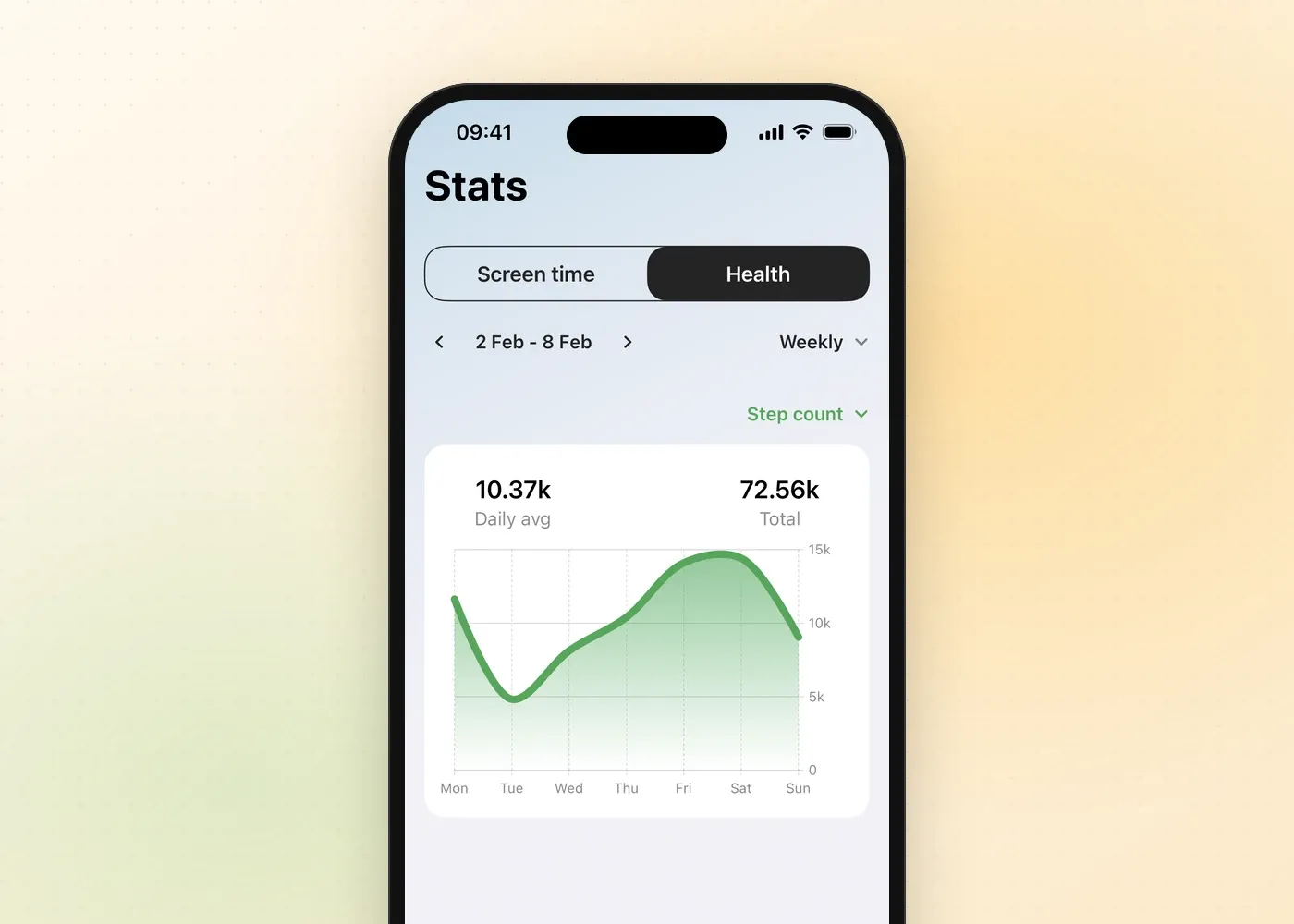
If your current average is lower than that, a smaller, specific goal tends to be easier to stick with than a round number borrowed from a 1965 advert. Fitlock’s rule builder lets you set a step count as the condition for earning screen time, for example 1,000 steps before your apps open up, a deliberately modest ask that’s easier to hit consistently than a 10,000-step target you might abandon by Wednesday.
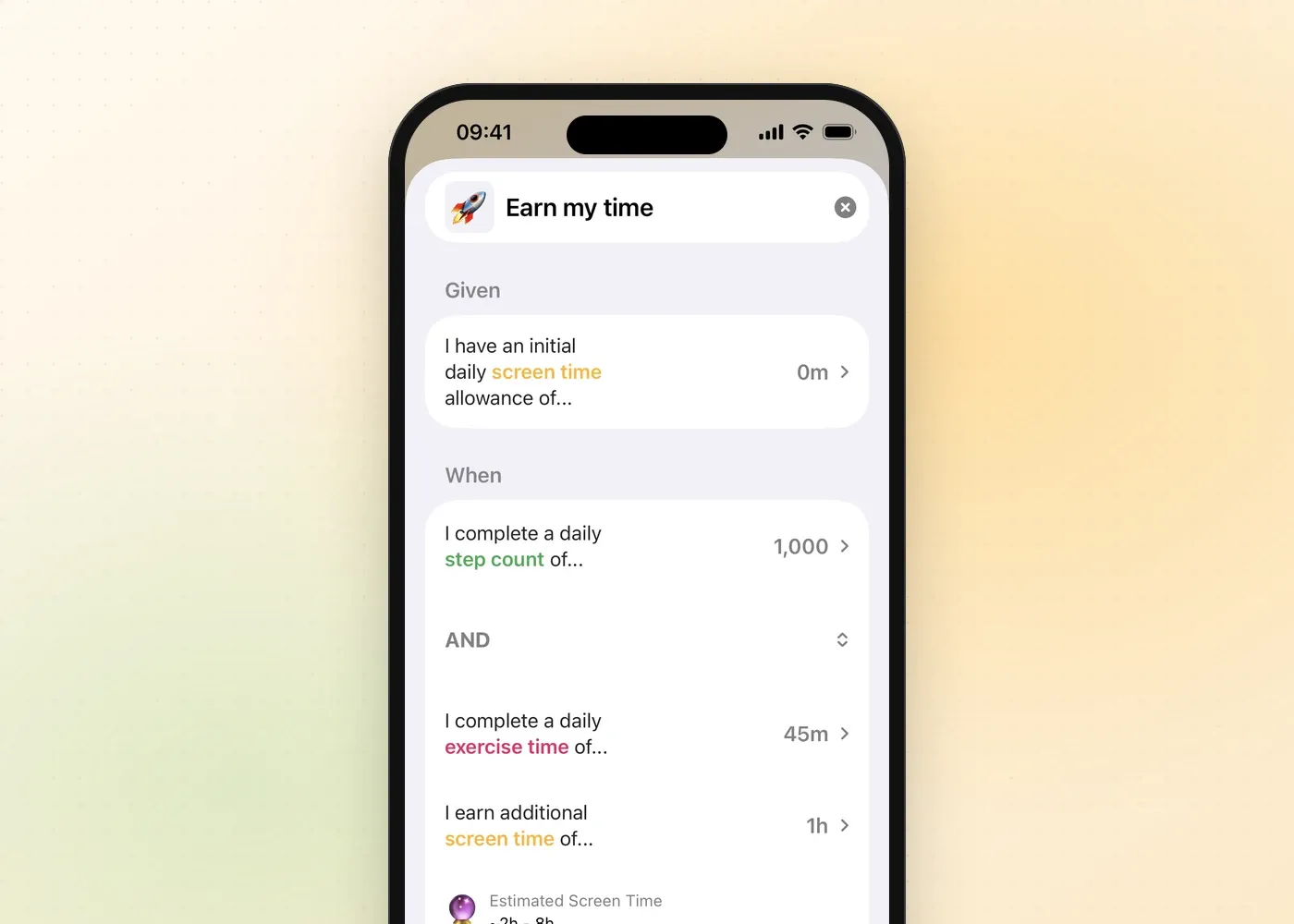
If steps are the metric you’d like to build a habit around, our guide to increasing your daily steps with Fitlock walks through setting up a rule like this from scratch. The FAQ explains how schedules work and what happens to your health data, and Fitlock Pro adds a monthly view and earlier weeks if you’d rather track trends over a longer period, plus goals like workout time for people who exercise in other ways.
Try it with Fitlock
Fitlock is the iPhone app behind those screenshots: it blocks chosen apps and websites until you hit a daily health goal, using Apple’s Screen Time framework, so it works across your whole phone rather than one app at a time. Steps are one of the goals available on the free tier, alongside wheelchair pushes and push-ups, with more options on Pro.